Police Records are the first stop for anyone needing an incident report free or a police report for an insurance claim, and the Bernalillo County Sheriff’s Office makes them accessible through a simple online portal. By entering the case number or the involved names, users can instantly view incident, offense, or accident reports while respecting police record confidentiality laws. If the desired file isn’t online, a request police records by mail using the county’s official form will trigger a modest police record retrieval fee.
Police Records also play a key role in background screening, legal defense, and employment checks, so confirming report numbers and matching dates is essential. The county’s public access guidelines outline which records are searchable, which are redacted, and how to request a police report correction procedure if errors appear. For faster results, follow police record search tips such as verifying the correct agency and using the police report verification service before filing a formal request.
How to Search Police Records
Police records searches in Bernalillo County usually begin with the bernalillo county Sheriff’s Office records area and depend on the agency that handled the call. The police report online portal can help you locate an incident, offense, or accident report by report number, case number, or an involved name. Some files appear without a paper request; other files require a form, identification, payment for copies, or a written explanation. Identifying the correct agency before searching helps prevent a false “not found” result.
Official Search Portal: https://www.bernco.gov/
Steps to Search
- Visit the official Bernalillo County Sheriff’s Office website and locate the records request page.
- Use the official search link and enter the report or case number.
- Search by the person’s full legal name if no case number is available.
- Apply date or location filters to narrow the results.
- Verify the incident details and document type before requesting a copy.
- Download the record if available and review any applicable fees.
- If no result appears, submit a written request to the responsible agency.
- Include all known details to help staff locate the correct record.
Requesting a Police Report Not Online
Use the request method named on the official records page. The county may offer an online form, a mail request, or email submission; a police file request template can help you keep the needed facts in one place. Send one request to the agency that holds the file, and do not assume a general county form covers police, municipal, court, or traffic records.
For a mailed request, use the destination printed on the records page and keep a copy of everything sent. For email, use only an address published for records requests, and avoid sending unneeded sensitive material. Ask whether the agency needs a signed release, proof of identity, or payment before it begins work.
Reports Needed for Insurance, Employment, or Court Use
A police report for an insurance claim, job review, or court case may need more than a casual search result. The report shows what officers recorded; it does not prove the final charge, plea, sentence, or settlement, which may appear in the court file. Ask for a certified copy when the recipient requires one, and request the court docket separately when case status matters. For a third-party background check, a written consent or release may be required by the agency, so ask about its form before paying.
Police Record Types
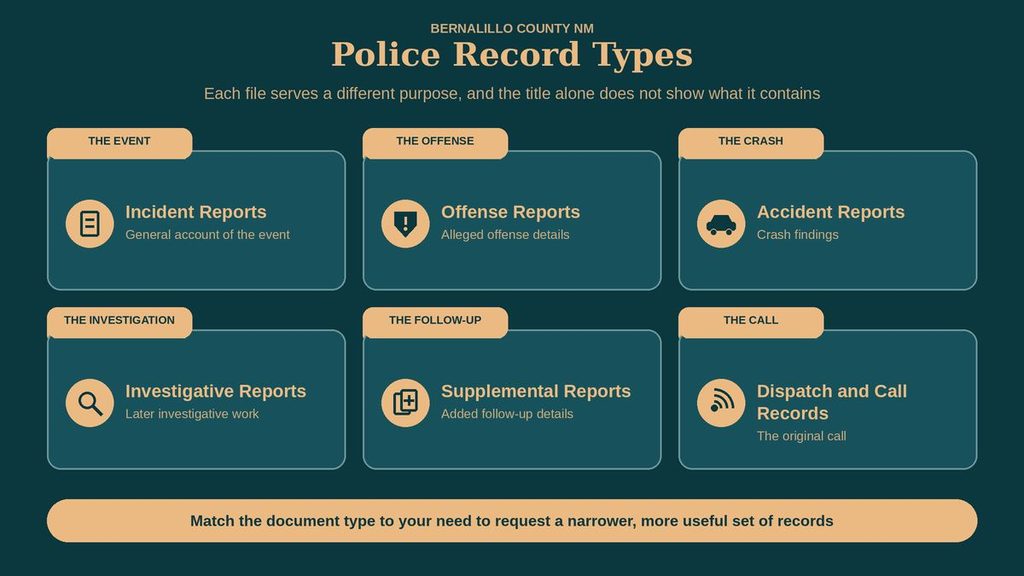
Bernalillo County police files cover several stages of an event, and each document serves a different purpose. The record title alone does not show whether the file contains the original call, alleged offense details, crash findings, or later investigative work. Matching the document type to your need helps you request a narrower and more useful set of records.
Incident Reports
An incident report records the basic facts known when a call was received or an officer responded. Common fields include the incident number, date and time, location, reported offense, involved names, narrative, and the officer or unit. The wording may show that something was reported rather than proven. Ask for the report tied to the event you need if one incident generated several case numbers.
Offense Reports
An offense report is tied to an alleged crime and may list the statute, arrest, citations, property, or investigative steps. It can differ from the court record because the court makes later decisions about charges and disposition. A police arrest records search through the portal may locate the report, but it cannot confirm that a person was convicted. For legal matters, compare both sources and keep their case identifiers together.
Accident Reports
An accident report documents a collision and commonly includes the crash date, road, vehicles, injuries, damage, citations, and diagram or witness details. The file may come from BCSO, the Albuquerque Police Department, New Mexico State Police, or another agency with crash-report duties. The report’s jurisdiction normally follows where the crash occurred and who investigated it. If the search shows no crash file, ask the highway or city agency that covered that road.
Investigative Reports
An investigative report gathers evidence and case reasoning. It may include interview notes, photographs, property lists, evidence links, and statements that did not appear in the first incident report. Full investigative files often contain exempt material, so the agency may release a redacted version, refuse part of the request, or refer the requester to a case file held in court. Ask for the public case report if the full investigative narrative cannot be released.
Supplemental Reports
A supplemental report adds facts after the initial report was written. It may correct a spelling, identify later evidence, or document follow-up interviews. The original and supplement often share a case number but carry separate report dates or document identifiers. Search both and request every supplement tied to the same incident when the full account matters.
Dispatch and Call Records
Dispatch and call records come from the communications system rather than the case-writing system. They may show when a call entered the queue, which units were sent, call duration, and callback attempts. Audio, caller details, and computer-aided dispatch notes can follow separate release rules and may sit with the communications center rather than the Sheriff’s Office case unit. Ask for the record type and agency that owns it instead of treating a dispatch entry as a complete police report.
Police Records by the Responsible Agency
The agency that received the call usually creates the first police record. Bernalillo County contains county, city, state, airport, federal, and tribal authorities, so a county address does not always point to the same records custodian. A request sent to the wrong office can lose time because staff cannot open a file held elsewhere.
Bernalillo County NM Sheriff’s Office Records
Choose the Bernalillo County Sheriff’s Office when the event was handled by BCSO deputies, county patrol units, or a contracted county service. BCSO records can include incidents, arrests, citations, and case reports created by its own units. A criminal case filed afterward may sit with the New Mexico court system, so ask BCSO for the police file and the court for the docket. Use the county records request area for written BCSO requests.
Municipal Police Department Records
Municipal police departments keep their own files, so county residents may need a city request rather than a county request. The Albuquerque Police Department is the main municipal example for incidents inside Albuquerque. Its report forms, fees, release rules, and portal can differ from BCSO procedures, even though both agencies serve Bernalillo County. Check the incident location and responsible city department before submitting one request to each.
Records by Jurisdiction
Records by jurisdiction usually follow the place of the incident and the agency with primary responsibility. APD commonly covers events in Albuquerque, while BCSO handles many events in unincorporated parts of Bernalillo County and may serve under contract. Multi-agency events can produce separate files, such as a crash report from one unit and an arrest report from another. Keep each agency’s report number in the request.
Determining the Correct Agency
Use the location, agency markings, and unit names to narrow the request. The table below offers common starting points, but a call can involve more than one agency.
Check the incident address, letterhead, patch, officer name, and unit listed on the report. A person’s home address in Albuquerque does not prove APD handled the call; the place where the event occurred carries more weight.
Records Held Outside County Jurisdiction
Records held outside the county can arise from state highways, federal facilities, airports, tribal lands, or nearby counties. A federal incident follows a federal request process, and tribal police records follow the sovereign agency’s rules. When state police hold a report, a state archive or state online request service may be the proper source. Court records, traffic citations, and police reports are separate files even when they describe one event.
Public Availability of Police Records
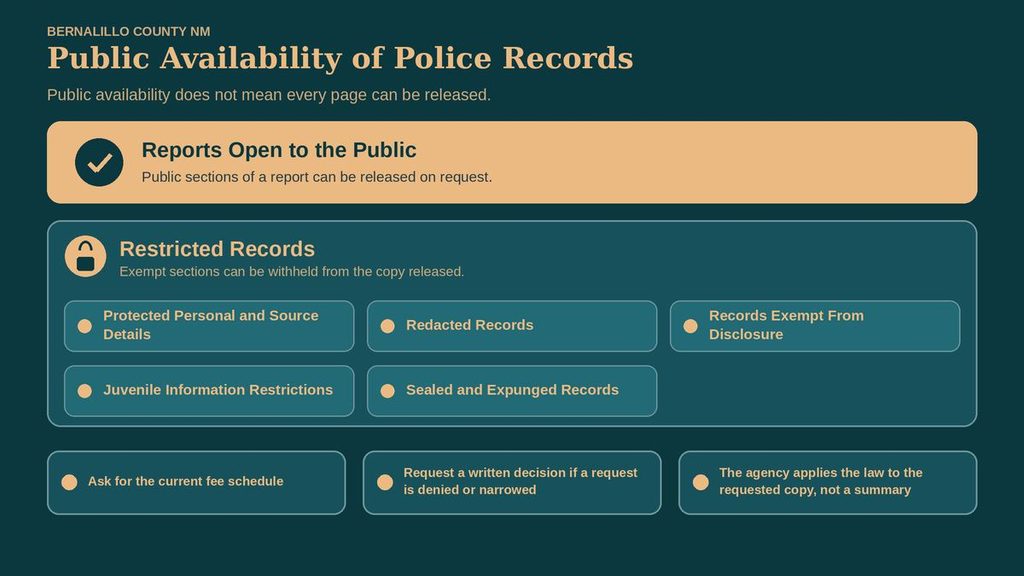
New Mexico’s Inspection of Public Records Act, NMSA 1978 §§ 14-2-1 through 14-16-6, supplies the basic public-records framework for state and local agencies. A report can have public sections and exempt sections, so public availability does not mean every page can be released. The agency applies the law to the requested copy, not a third-party summary. Ask for the current fee schedule and a written decision when a request is denied or narrowed.
Reports Open to the Public
Many final incident reports can be requested and viewed after routine redactions. Under IPRA, inspection of public records carries no charge, though reasonable charges may apply for copies and delivery. A free portal view does not mean a free certified paper copy. Check the current fee schedule before ordering, and ask how the agency calculates charges for copies, delivery, and certification.
Restricted Records
A restricted record is withheld or released only in part because a statutory exception applies. Examples can include active investigation details, confidential source identity, privileged material, evidence handling, or facts that could harm a person’s safety or privacy. The agency should give a written response that identifies the legal basis for withholding or narrowing the request. Ask whether a redacted public version can be produced instead.
Protected Personal and Source Details
Protected details can include home addresses, personal phone numbers, identifying data about people who were not suspects, medical details, and source data. The agency may remove those fields while releasing the narrative. A listed name does not by itself make the whole record confidential. Request the standard public version first, then ask for a clear written reason if you believe a redaction covers more than the law requires.
Redacted Records
A redacted record is a released version with exempt words, names, or pages removed. Compare the page count with the request and ask whether material was withheld under a stated exception. A redaction does not tell you whether another agency has a separate report. For legal or administrative use, ask whether the agency can identify the legal basis for each redaction without revealing the protected content.
Records Exempt From Disclosure
New Mexico law lists specific categories that fall outside routine public inspection. Records can be exempt for reasons tied to investigations, government personnel, personal privacy, pending court matters, or confidential sources. The exact exception depends on the requested record and the facts behind it. Keep the request narrow so the agency can review the public portions and apply any valid exemption to the protected portions.
Juvenile Information Restrictions
Juvenile records receive separate legal protection under New Mexico law, including NMSA § 22-10-2. A juvenile court file may contain intake, detention, diversion, and disposition material that does not appear in the police portal. Ask the Juvenile Court for its release procedure and provide the required identifying facts. Do not assume a parent, school, employer, or lawyer can receive every juvenile record without authorization.
Sealed and Expunged Records
Sealing and expungement involve court orders, so the police search portal alone cannot show whether either has occurred. A sealed file may require a court to review a request, and an expungement petition follows the court’s rules rather than a portal button. Ask the court clerk for the case status and any sealing or expungement order. If an agency still lists the incident, ask that agency how it handles a court-ordered sealing or expungement order.
Police Records Updates and Corrections
A police file can change after its first release, but not every change takes the same form. Checking official probate court records provides direct confirmation when evaluating public records. Some updates add new facts, some correct errors, and others come from a court or jail system. Identify the type of change you need before sending a correction request.
Supplemental Reports
Supplemental reports add material after the first report was written, such as follow-up interviews, recovered property, new photographs, or corrected names. Treat them as separate documents linked to the same case. A complete request should name the original report and ask for all supplements. This avoids a file that begins correctly but ends before the investigation closed.
Updated Case Information
Updated case information may come from court records, jail records, or the agency’s case-management system rather than a rewritten police narrative. An arrest can later end in dismissal, diversion, a plea, or conviction, yet the initial report may remain unchanged. Ask for a certified disposition or court docket when the outcome matters. Do not describe an arrest entry as proof of guilt or a conviction.
Corrected Reports
A corrected report alters the original document because staff found a factual or clerical error. Common examples include a misspelled name, wrong address, incorrect date, or mistaken unit number. The agency may note the correction inside the file or issue a replacement page. Ask which method it used and request a certified copy that displays the correction. A supplement that merely adds facts does not replace a correction request.
Administrative Changes
Administrative changes affect labels or metadata rather than the event itself. Examples include a corrected agency code, report-number format, address standardization, or document date. Such changes help offices sort and retrieve files, but they do not prove the narrative changed. Compare the header and body before deciding that the agency ignored an error.
Requesting a Police Record Correction
Prepare one specific correction request for each disputed fact. A clear request is easier to review than a general complaint about the entire report.
- Identify the report number, case number, page, and line where the problem appears.
- Quote the incorrect statement and state the accurate fact in plain language.
- Attach documents that support the proposed change, such as a citation, court docket, property record, or signed statement.
- Send the request through the official records channel and ask for a written decision on the proposed correction.
- Ask whether the original page stays in the file, whether a replacement page is issued, and whether a certified copy can show the change.
Keep a copy of the original report, your supporting documents, and every written response. If the dispute affects a court case, a legal professional can assess whether a records correction, court request, or case filing is the better route.
Police Records Verification
A search result is a starting point, not proof that the result matches the event or person you mean. Verification links the document number, names, date, place, and agency to independent facts. This process catches false matches before a background check, claim, court filing, or legal request relies on the wrong file.
Choosing a Police Report Verification Service
Use a verification service that traces the file back to the agency that created it. An agency-issued PDF, a county confirmation, or a certified copy carries more weight than a name on a private search page. A third-party service can help narrow the search, but it cannot remove redactions or promise that an incident was reported. Keep the agency name and report number with any verification result.
Confirming Report Numbers
Report number and case number serve different purposes. The case number can group the incident report, supplemental reports, arrest documents, and related citations. Each report can still have its own document identifier. Confirm every character, including prefixes and suffixes, and ask the agency which number works best for a full file request.
Matching Names and Dates
Match the record using the full legal name, date of birth when the agency requires it, and the exact incident date. A middle name, suffix, former name, or spelling used by the caller may differ from later documents. Compare several facts instead of relying on a common name. A close date without the correct name can point to a different case.
Checking the Reporting Agency
Read the first page for the agency name, unit, officer, signature, and report heading. A report handled by a deputy sheriff differs from one created by APD, even when both documents list the same event. Confirm that the agency shown on the record matches the agency that holds the file. Mixed-agency incidents often require separate requests.
Confirming Incident Locations
Compare the street address, intersection, highway mile marker, or landmark with the place where the event occurred. Boundary areas can involve different agencies, and a report may describe both a road name and a cross street. Use the incident location rather than the requester’s address to decide which agency should receive the request.
Comparing Original and Supplemental Records
Place the original report and its supplements side by side. Confirm that the case number matches, the dates follow a sensible order, the page numbering is complete, and attached items are present. A supplement can correct a name or add a new interview without replacing the first report. Ask for a certified combined copy when a court, employer, or insurer needs one continuous file.
Police Records Search Problems
Most failed searches trace back to a mismatched identifier, wrong agency, processing delay, or legal restriction. Work through those points before assuming that no report exists. A written request can help when the portal cannot search an older file, a name variation, or an agency’s full index.
Record Not Found
A blank result does not prove that no police response occurred. It may mean the file uses another identifier, sits in a manual archive, or belongs to a different agency. Confirm the agency and report number first. If both check out, send a written request with broader name and date details, and ask staff to search incident, arrest, and citation indexes.
Incorrect Name or Spelling
Search with the full legal name and each spelling used by the person involved. Include a middle name, suffix, former name, or nickname only when you know the agency used it. Dates help separate people with the same name. If the search still fails, state in the written request that the name may have been recorded differently.
Incorrect Report Number
Copy the number directly from the source instead of typing it from memory. Omit spaces only if the agency says its search accepts that format. Check whether the digits are a case number, report number, citation number, or another identifier. When the number remains unclear, provide the incident date, location, and names so staff can perform a broader search.
Wrong Law Enforcement Agency
The reporting agency may differ from the county named in a mailing address. Use the incident location, officer affiliation, and agency heading to find the correct custodian. State Police, APD, BCSO, airport police, and tribal agencies each handle different areas or events. Sending a request to the wrong agency does not move it to the proper office.
Recent Record Not Available
A recent report may still be in review, approval, or digitizing. Search again after the agency confirms that the file has been added to the online index. If the incident involved an arrest, citation, or follow-up visit, ask for supplemental reports filed after the first incident date. Request a review date instead of assuming a fixed release delay.
Restricted or Redacted Record
A restricted result differs from a missing record because the agency has located the file but applied a legal protection. A redacted result may contain most of the report with protected portions removed. Ask for the legal basis of the restriction, the pages withheld, and whether a narrower request can release the remaining public material.
Delayed Record Availability
For a written IPRA request, the standard response period is 15 business days after receipt. The law permits one extension for good cause if the custodian gives written notice. A portal search or records-unit queue may follow another schedule, so keep the submission date and any receipt confirmation. If the standard period passes without a response, send a dated follow-up asking for the custodian’s decision and next steps.
Contact Details
Use the Bernalillo County Government contact details for questions about the county website, records request method, or current copy charges. Reports tied to APD, state police, a court, or another agency must be requested from that custodian. Keep the official county website open during the request so you can follow the latest published procedure.
Frequently Asked Questions
Police records give citizens clear insight into incidents, arrests, and investigations. Accessing these files helps with insurance claims, employment checks, and personal safety. In Bernalillo County, the sheriff’s office and local police departments manage the online portal, mail requests, and in‑person pickups. Knowing the steps, fees, and legal limits saves time and avoids surprise costs.
How can I obtain a police incident report free in Bernalillo County?
Start at the Bernalillo County Sheriff’s online portal. Enter the report number, case number, or involved name. If the report is marked public, you can download a PDF at no cost. For restricted files, submit a written request with ID and a brief explanation. The office typically replies within ten business days.
What fees apply when requesting police records by mail?
Mail requests incur a copy fee of $5 per page plus a processing charge of $10. Payments accepted are checks or money orders payable to the Bernalillo County Sheriff’s Office. Include the request form, a copy of your ID, and a self‑addressed stamped envelope. The department sends an invoice if fees exceed $50.
Can I use the police report online portal for an insurance claim?
Yes. Locate the incident report using the portal, then download the official PDF. Insurance companies accept the document as proof of loss. Verify that the report includes date, time, location, and officer name; these details satisfy most claim requirements.
How does the police record expungement process work in New Mexico?
File a petition with the district court where the arrest occurred. Attach the arrest record, a statement of why removal is needed, and any supporting documents such as proof of rehabilitation. After a hearing, the judge may order the record sealed or destroyed. The sheriff’s office updates the database within 30 days.
What steps should I follow to correct an error on a police report?
Contact the records division that issued the report. Submit a written correction request that cites the mistake, includes the report number, and attaches evidence (photos, witness statements). The division reviews the claim and, if valid, issues an amended report within two weeks. Request a copy of the corrected version for your records.
Are police records available for background screening and employment?
Employers may request a criminal history check through the state police record archive. Provide the applicant’s consent, full name, and date of birth. The archive returns a summary of arrests, convictions, and dispositions. Some employers use a verification service that cross‑checks the data with the Bernalillo County portal for added accuracy.